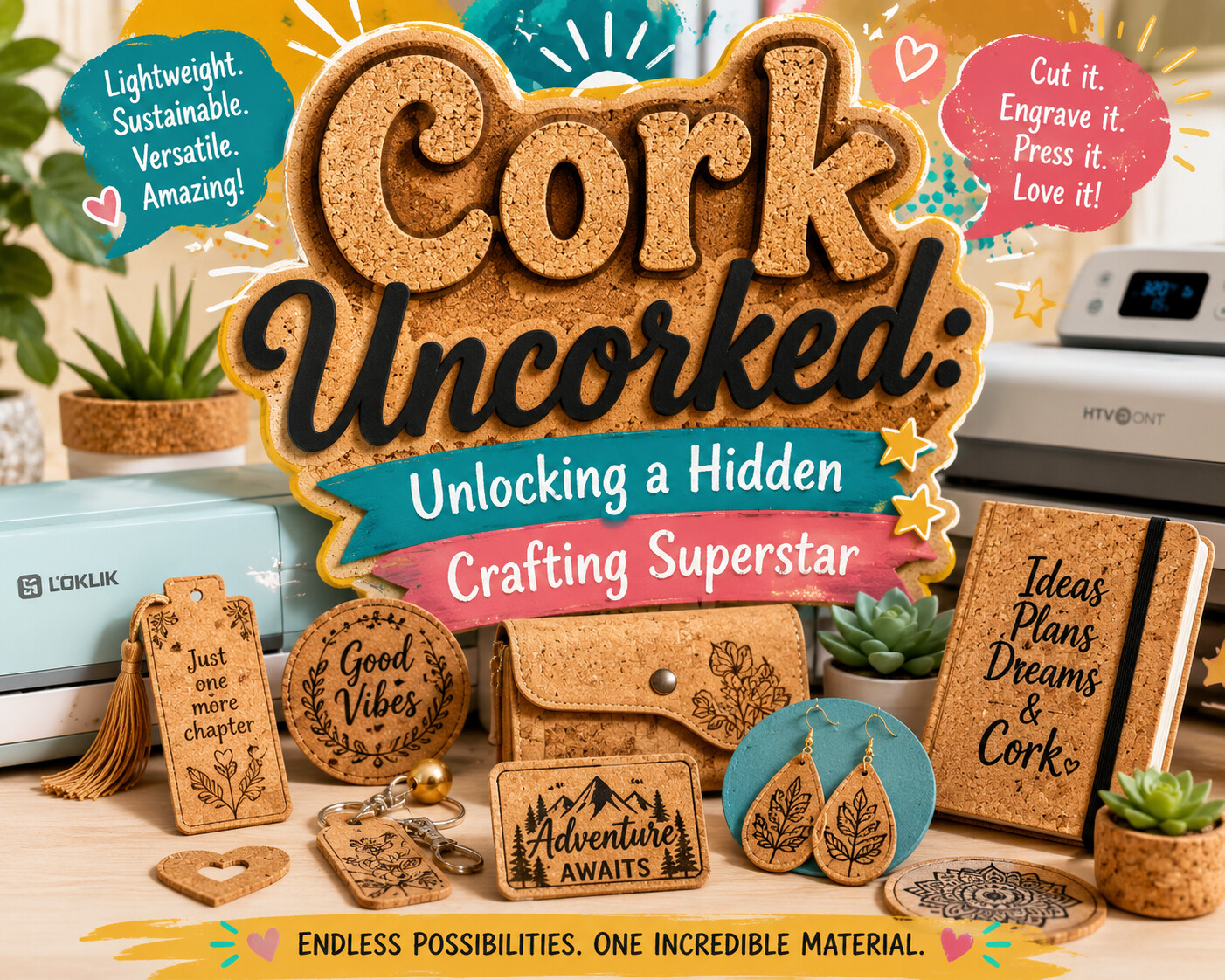
Let’s talk about a material that doesn’t get nearly enough attention.
It doesn’t sparkle.
It doesn’t come in dozens of colors.
It isn’t trending on social media.
And yet it might be one of the most versatile materials sitting in your craft room right now.
I’m talking about cork.
For many makers, cork immediately brings one thing to mind: coasters.
Maybe a bulletin board.
Perhaps a wine bottle stopper if you’re feeling adventurous.
But if that’s where your imagination stops, you’re missing out on one of crafting’s best-kept secrets.
Cork is lightweight, flexible, sustainable, easy to work with, and surprisingly compatible with many of the machines and techniques we already use every day. Whether you’re a laser crafter, heat press enthusiast, vinyl artist, paper crafter, or mixed media maker, cork has something to offer.
The real question is:
Have we been underestimating cork all along?
What Makes Cork So Special?
Unlike wood, cork has a unique cellular structure filled with microscopic air pockets.
Those tiny pockets give cork its signature characteristics:
• Lightweight yet durable
• Naturally water resistant
• Flexible without breaking
• Excellent thermal insulation
• Soft texture with visual warmth
• Renewable and environmentally friendly
The result is a material that behaves differently than almost anything else in our craft rooms.
It has the warmth of wood.
The flexibility of fabric.
The texture of leather.
And the workability of cardstock.
Few materials can claim all of those qualities at once.
Beyond Coasters: Creative Cork Projects
If you’ve only used cork for coasters, you’re just scratching the surface.
Cork can be transformed into:
• Earrings and jewelry
• Keychains
• Bookmarks
• Journal covers
• Wall art
• Layered signs
• Plant markers
• Home décor accents
• Ornaments
• Tote bag embellishments
• Mouse pads
• Hat patches
• Custom trivets
• Wedding favors
• Mixed media artwork
• Shadow box elements
Its natural texture adds instant warmth and character to projects that might otherwise feel flat or sterile.
Laser Cutting Cork: Best Practices
Laser users often discover that cork cuts beautifully when properly secured.
Because cork is lightweight, airflow can sometimes cause movement during cutting.
A few tips for better results:
• Secure thin cork sheets with magnets, weights, or honeycomb pins.
• Use moderate air assist to reduce scorching while avoiding excessive movement.
• Focus carefully because cork thickness can vary across the sheet.
• Run small test cuts before committing to large projects.
One of cork’s biggest advantages is that it typically produces cleaner edges than many paper products while requiring less power than wood.
The result is crisp cuts with minimal cleanup.
Laser Engraving Cork: Where the Magic Happens
This is where cork truly shines.
The contrast produced by laser engraving can be stunning.
Logos.
Monograms.
Maps.
Illustrations.
Patterns.
Quotes.
Photographs.
Many designs develop a rich dark contrast against the natural tan surface of the cork.
Some tips for engraving success:
• Start with lower power settings than you would use for wood.
• Multiple light passes often produce cleaner results than one aggressive pass.
• Test different line intervals for optimal detail.
• Use masking if your machine tends to leave residue.
• Remove dust with a soft brush rather than excessive wiping.
One of the most beautiful aspects of engraved cork is that no two pieces look exactly alike. Natural variations create unique character in every project.
Can You Heat Press Cork?
Absolutely.
Many crafters are surprised to learn how well cork can work with heat transfer applications.
Heat transfer vinyl can adhere beautifully to many cork products when proper temperature and pressure are used.
Some makers even combine engraving and HTV for stunning layered effects.
Imagine:
A laser engraved cork coaster with metallic HTV accents.
A journal cover featuring engraved artwork and a personalized name.
A cork patch with a heat applied logo.
The combination of texture and color can create incredibly professional results.
As always, perform test presses first because cork products vary significantly between manufacturers.
Cork and Vinyl: A Perfect Match
Permanent adhesive vinyl works wonderfully on smooth cork surfaces.
This opens up endless customization opportunities.
Personalized gifts.
Business branding.
Decorative labels.
Custom home décor.
Layering multiple colors of vinyl onto cork often creates a high-end boutique appearance.
The natural texture underneath adds visual depth that flat surfaces simply cannot replicate.
Mixing Cork with Other Materials
This is where creativity truly takes over.
Try combining cork with:
Wood for warmth and contrast.
Acrylic for modern layered designs.
Leather for luxury accessories.
Faux leather for lightweight wearable art.
Cardstock for dimensional paper projects.
Fabric for mixed media décor.
Metallic HTV for eye-catching personalization.
Some of the most impressive projects don’t rely on cork alone. They use cork as one ingredient in a larger creative recipe.
Common Challenges and Solutions
Like any material, cork has its quirks.
Challenge: Surface variations.
Solution: Embrace them. Natural imperfections often enhance the finished project.
Challenge: Thin cork curling.
Solution: Store sheets flat and secure them during cutting.
Challenge: Excessive engraving depth.
Solution: Reduce power and increase speed.
Challenge: Vinyl lifting from textured surfaces.
Solution: Increase pressure slightly and allow adequate cooling before handling.
Why More Makers Should Experiment with Cork
In a world filled with acrylic, wood, cardstock, and vinyl, cork often gets overlooked.
Yet it offers a combination of texture, flexibility, sustainability, and versatility that few materials can match.
It can be elegant.
It can be rustic.
It can be modern.
It can be whimsical.
It can stand alone or complement nearly every other material in your workshop.
Sometimes the most exciting crafting discoveries aren’t the newest materials.
They’re the materials that have been sitting quietly on the shelf waiting for us to notice their potential.
So let’s hear from the community!
Have you worked with cork before?
What’s your favorite cork project?
Do you have laser settings, heat press tips, or creative techniques you’d be willing to share?
And most importantly…
What’s the most unexpected thing you’ve ever made from cork?