I love this question — it really gets the imagination going. There are a few “future‑tech” ideas I’ve daydreamed about where a heat press could be the perfect tool, even if the materials or technology don’t exist yet. Here are a few of my favorites, with a little context so they make sense:
Heat‑pressed 3D shapes or sculpted designs
Imagine a special material that expands or rises in controlled areas when heated. You’d press a flat sheet and end up with dimensional flowers, ornaments, or wall art. Almost like a pop‑up effect created with heat and pressure.
Wood embossing or engraving without a laser
A press with more precise heat zones could darken or compress wood to create engraved‑style designs. Same look as a laser, but using heat and pressure instead of a beam.
Color‑changing decorative wall panels
Not the actual wall — more like peel‑and‑stick panels or framed décor made from heat‑reactive material. You’d press them once to activate a color shift or reveal a hidden pattern, then hang them like any other décor piece.
Ceramic‑style transfers without a kiln
This imagines a new type of low‑temp coating that behaves like ceramic glaze. Instead of firing a tile at 1200°F, you’d press it at crafting temperatures and the coating would melt, flow, and cure into a glossy, permanent finish.
Fabric sculpting
Some fabrics can already be shaped with heat, but imagine materials that hold more dramatic textures — raised patterns, origami folds, sculpted pillows — all locked in with a press.
Custom holographic effects
Instead of buying holographic vinyl, imagine being able to create the hologram during the press by rearranging microscopic layers with heat and pressure.
These are definitely “dream big” ideas, but that’s what makes this kind of question fun. I love imagining where heat‑press technology could go in the future.
And in terms of barriers in my workflow, the biggest one for me is alignment. I can get things straight, but it definitely slows me down. When I’m working on dark garments, layered HTV, or anything that needs precise placement, I always have to stop, measure, re‑measure, and double‑check. A built‑in alignment system — whether that’s LED guides, a projection grid, or even an auto‑alignment function — would make a huge difference.
Here are a few other areas where conventional presses could be more seamless:
Switching between materials takes time
Different vinyls and fabrics all need different temps, times, and pressures. A press that could auto‑suggest or auto‑detect settings would streamline things.
Pressure adjustment isn’t very precise
Most presses use manual knobs, so you’re guessing the pressure level. A digital pressure readout would make it easier to repeat perfect results, especially for layered HTV or thicker items. I know the HTVRONT Auto Heat Press and the H10 Heat Press have a digital display / pressure adjustment, but I’d like to see more swing arm presses have this feature.
Limited space for larger or odd‑shaped projects
Totes, pillows, long signs, and wood boards can be tricky to position. A wider opening or sliding base would help with alignment and reduce mistakes.
Uneven pressure on textured or non‑flat surfaces
Canvases, seams, zippers, and wood pieces often need pressing pillows or multiple presses. A platen that adapts to uneven surfaces would eliminate that extra step.
Heat‑up and cool‑down time
Switching between materials or temperatures can slow down production. Faster heat‑up or a rapid‑cool feature would be a huge workflow boost.
These aren’t complaints — just areas where future innovation could make the process even more efficient for all kinds of crafters.
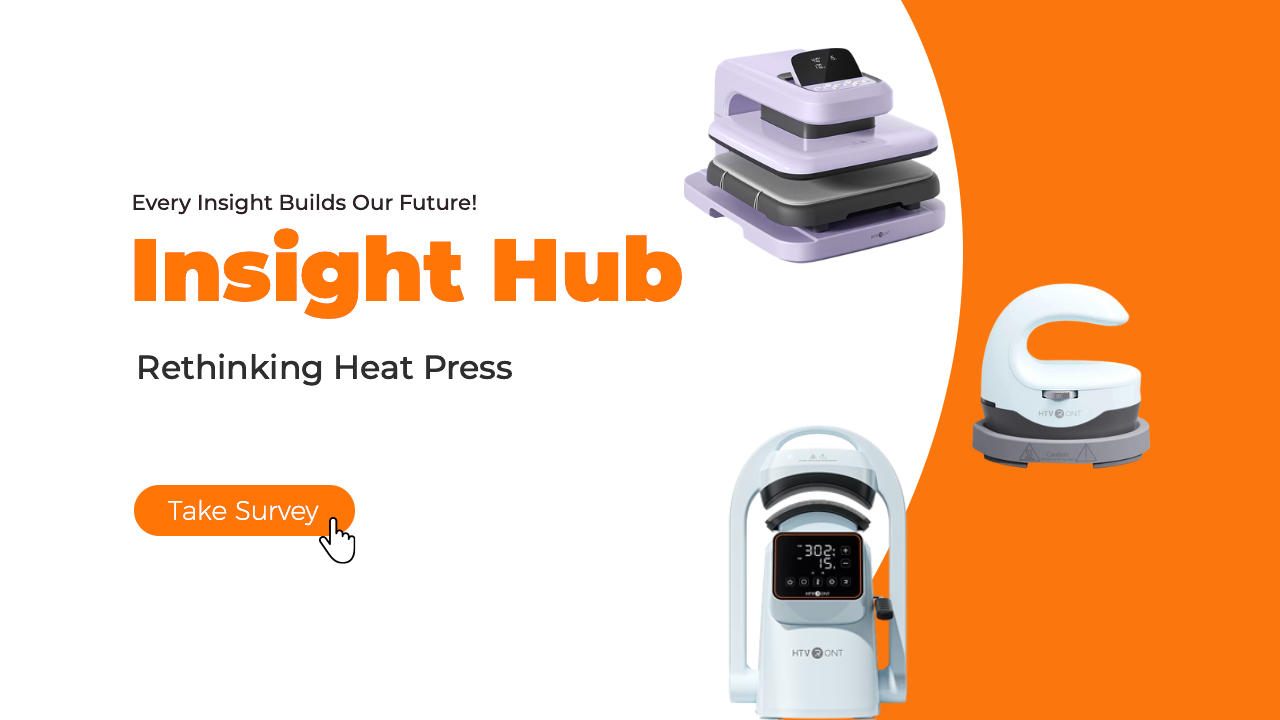
 Welcome to a new edition of Insight Hub!
 If heat press machines were not limited to today’s forms, sizes, or use cases, what would you truly want to create?
 What new products or categories would you love to make or sell using heat press?
 All ideas are welcome, share whatever you think!
 How to Join
 Small Reward


